
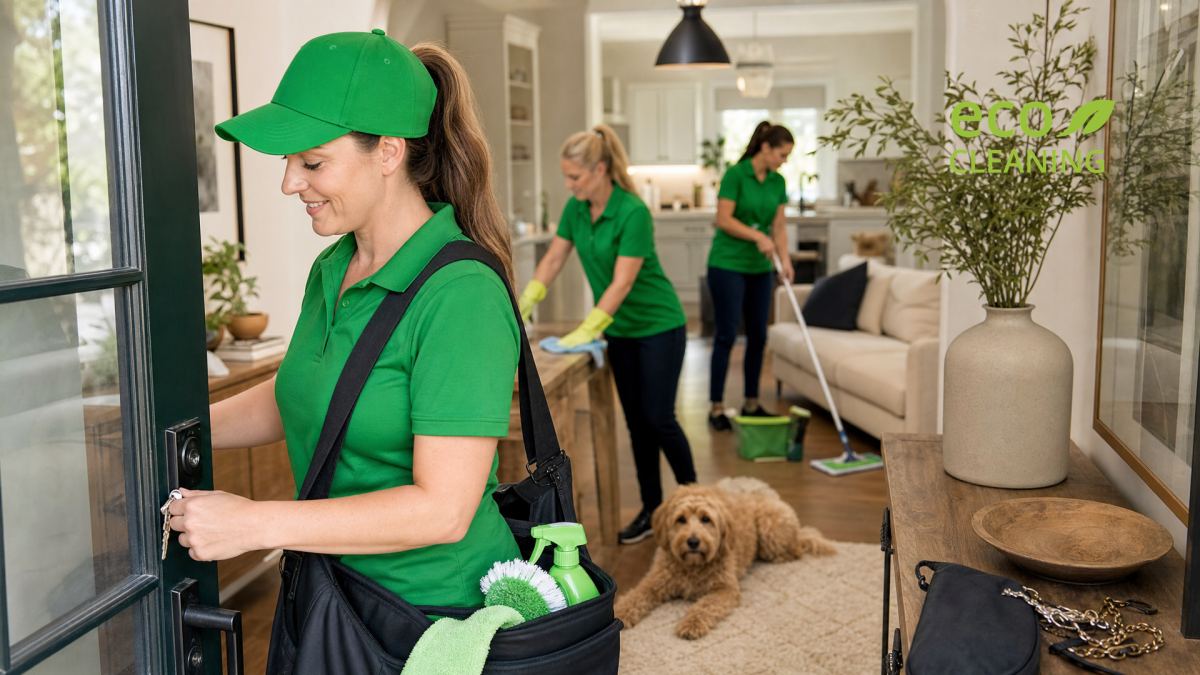
Booking house cleaners for the first time brings up a handful of small, practical questions that have nothing to do with how well a home gets cleaned. Should you be there when they arrive? Who holds a key, and for how long? What happens with the dog, the cat, the jewelry box on the dresser? None of these questions are trivial, because the answers shape how comfortable the first visit feels and how much the crew can actually accomplish. This guide walks through access, pets and valuables in the order most people need to decide them, so the first appointment starts on solid ground rather than guesswork.
Should you be home for the first cleaning visit?
The first thing to check is whether your schedule even allows you to be present, because the answer removes half the decision. Eco Cleaning Service says customers do not need to be home during a cleaning, and that many clients provide a lockbox code, a garage code or a hidden key so the crew can access the home while they are at work or running errands. Customers who prefer to be home can be, so neither choice is treated as unusual.
The practical difference is in what the first visit accomplishes. On a first clean, the team walks the space with the customer and notes their priorities, saving them for later visits, since the first visit establishes the cleaning baseline before the company confirms the maintenance scope and price for the schedule chosen. A homeowner who can be present for even the first ten minutes gets to point out specific concerns in person rather than relying on written notes. Eco Cleaning also recommends a first deep cleaning to address accumulated buildup, and that visit is priced separately from ongoing recurring cleanings, which is another reason a short walkthrough at the start can be worth the time.
If anyone in the household has asthma or allergies, timing matters more than presence. The EPA's asthma-trigger guidance says people with asthma or allergies should leave the area being vacuumed, and the Asthma and Allergy Foundation of America suggests wearing a mask while doing housework and leaving the house for several hours after cleaning it. Neither source is specific to professional cleaning visits, but the logic applies directly: if a household member reacts to dust or vacuuming, planning to be elsewhere during and shortly after the visit is a reasonable precaution, whether or not anyone else stays home.
Keys, entry codes and garage access: what to arrange and what to ask
Once the presence question is settled, access method is the next decision, and it has a few workable options. A lockbox code, a garage code, or a hidden key are the arrangements Eco Cleaning says many clients already use, and entry instructions are shared directly with the team when confirming the visit. Each of these simply needs to be communicated before the appointment rather than explained on the doorstep.
Before settling on a method, it helps to ask a few questions that aren't answered on a company's website by default, since every cleaning company handles the mechanics differently. How is a key or code stored between visits? Is it returned, kept on file for recurring service, or destroyed after a one-time cleaning? Is the same code used for every visit, or does it change? These are reasonable questions to raise directly with whichever company you hire, including Eco Cleaning, because the answer affects how comfortable you'll feel about ongoing access versus a single appointment.
What does carry some weight in that decision is who is actually coming through the door. Eco Cleaning states that every cleaner is a trained, background-checked employee of the company, not a subcontractor. It doesn't replace asking the specific storage and return questions above, but it's a relevant piece of context when deciding whether a lockbox code feels like a reasonable arrangement for your household.
For garage access specifically, the same principle applies: if a garage code also opens an interior door or controls other smart-home features, it's worth confirming with the company how narrowly that access is used and whether it's limited to the cleaning window itself.
Pets on cleaning day: containing, informing and avoiding surprises
Pets introduce a different kind of planning, because the goal isn't just controlling access, it's avoiding a stressful or unsafe moment for the animal and the crew. Eco Cleaning asks customers to share allergies, pets, surface concerns or scheduling needs before the first cleaning visit, and specifically to mention basements, pets and priorities so the team can allow enough time. The company's free estimate form also includes a field for priorities, pets or special requests when booking, which is the practical place to flag a skittish cat, a large dog, or an aquarium that shouldn't be disturbed.
For dogs specifically, containment is worth planning even if your dog is generally friendly. The ASPCA lists the approach of strangers, the approach of people in uniforms, and loud noises such as appliances among common triggers of dog aggression, and advises keeping a dog that overreacts to visitors or delivery personnel in another room when they come to the house. A vacuum running, or a crew member in work clothes moving through unfamiliar rooms, fits both of those triggers even for dogs that are calm around family. The U.S. Postal Service advises placing a dog in a separate room and closing that door before opening the front door to a mail carrier, noting that some dogs burst through screen doors or plate-glass windows to attack visitors. That's a stronger warning than most pet owners expect, and it's a useful reminder that a closed door, not just a baby gate, is the safer choice for an excitable dog on cleaning day.
Whatever the pet, telling the crew in advance beats explaining the situation while they're already standing in the doorway. How Eco Cleaning's team prefers to work around pets on the day itself isn't published in detail, so it's worth asking directly when you book, especially if your pet has specific triggers the crew should know about.
Valuables, private rooms and items to set aside
Deciding what to put away is really a question of categories, not a room-by-room inventory. Documents, jewelry, cash, and small high-value items are the obvious first group, simply because any household with unsupervised visitors, including repair technicians, guests or cleaners, benefits from keeping those items in a drawer or safe rather than on open display. This isn't a comment on any particular company's trustworthiness; it's a basic practice that reduces ambiguity for everyone involved.
Medication deserves its own mention. Nemours KidsHealth recommends storing medicines in their original containers in a dry, locked location that children can't reach, and specifically calls a bathroom medicine cabinet a poor choice for most medicines because of humidity. That advice is written for households with kids, but the underlying point, that a locked, dry location is better than an open cabinet, holds regardless of who else is in the house that day.
If there's a room you'd rather the crew skip entirely, such as a home office with sensitive paperwork or a room mid-renovation, say so during the first-visit walkthrough. That's the same conversation where the team notes priorities for future visits, so flagging an off-limits room at that point folds naturally into the plan rather than requiring a separate conversation later. Eco Cleaning states that every visit is backed by $2,000,000 in general liability insurance, which is the company's own statement about coverage; the specific terms, claims process and what situations are covered aren't published, so if you have a particularly fragile or valuable item you're worried about, it's worth asking the company directly how a damage or loss concern would be handled before the visit rather than after.
A short tidy before the cleaners arrive
A light pickup beforehand isn't about doing the crew's job for them, it's about letting them reach the surfaces you're paying them to clean. Eco Cleaning's deep cleaning service asks customers to say which rooms and surfaces matter most so the work and time can be agreed on, and its checklist refers to detailing accessible baseboards and trim, dusting accessible furniture and fixtures, wiping accessible vents and registers, and cleaning beneath safely accessible furniture. The word "accessible" shows up often in that list for a reason: a crew can't clean under a bed piled with storage boxes or wipe a vent blocked by a laundry basket.
In practice, that means a quick pass through each main room: clearing countertops of loose items, picking stray clothes and toys up off floors, and making sure furniture that needs to be cleaned beneath isn't blocked by boxes or bags. It doesn't mean deep organizing or scrubbing anything yourself; that's the job you're hiring for. It also helps to clear a path to areas you've flagged as priorities, since a cluttered doorway to a basement or a crowded closet floor eats into the time allotted for the rooms that matter most to you, something Eco Cleaning specifically asks customers to mention in advance so enough time can be planned.
One detail that isn't published anywhere is whether crews move personal items, like a stack of mail or a pile of folded laundry, out of the way themselves during a visit. Assume they won't unless told otherwise, and ask directly if you're unsure, since policies vary by company and by how a given space is set up.
Agreeing on contact and feedback for during and after the visit
A clear communication plan closes the loop on everything above. Eco Cleaning Service lists (630) 286-9010 as the fastest way to reach the company, with hours Monday through Sunday, 24/7, and says appointments are available daily with online booking available 24/7. For a first-time booking, that number is also the simplest way to settle access, pet and valuables questions ahead of time rather than over email. The company also states that it replies to estimate requests within 30 minutes during business hours, which gives a rough sense of how quickly a scheduling question gets answered if you're still deciding on a plan.
After the visit, the company asks customers to report anything missed within 24 hours, so it can return and make it right. That window is worth keeping in mind if you're doing a final walkthrough the same day the crew leaves, since a concern raised a week later falls outside that stated policy. For recurring service, Eco Cleaning says it aims to send the same team whenever possible, subject to availability, which matters for households that valued the first-visit walkthrough and want future visits handled by people who already know the priorities noted that day. How damage specifically gets reported and resolved isn't detailed on the company's public pages, so if that's a concern for your home, it's a fair question to raise directly when you book rather than something to assume either way.
Frequently asked questions about house cleaners and first-visit access
Do I have to give house cleaners a key to my home? No single method is required. A lockbox code, a garage code, a hidden key, or simply being home to let the crew in are all workable options, and the right choice depends on your schedule and comfort level rather than any fixed rule.
What should I tell house cleaners about my pets before the first visit? Mention the type of pet, its temperament around strangers, and where you'd like it contained during the visit, ideally when you book rather than at the door. A closed room, not just a gate, is the safer choice for dogs that react to visitors or unfamiliar noises.
Should I lock away valuables before a house cleaning? Putting jewelry, cash, important documents and medication in a drawer, safe or locked cabinet is a reasonable precaution for any unsupervised household visit, cleaning included, and it removes any ambiguity about what was where beforehand.
How much should I clean before house cleaners arrive? A light pickup, clearing counters, floors and furniture tops, helps the crew reach the areas you want addressed within the time planned for the visit. It isn't necessary to deep clean or organize beforehand.
What if something is missed or damaged during the visit? Report it as soon as you notice it. Eco Cleaning Service asks customers to flag missed items within 24 hours so the team can return and address them, and any damage or access concern is best raised directly with the company by phone.
Deciding whether to be home, how to share access, where pets go, and what to set aside isn't complicated once it's broken into these five pieces, and most of it only needs to be settled once. A short conversation when you book, whether by phone or through an estimate form that asks about priorities and pets, covers nearly everything above before the crew ever arrives. For Naperville-area households ready to schedule a first visit, Eco Cleaning Service's recurring and deep cleaning options both start with the same walkthrough described here, making that first appointment the moment your priorities get recorded for every visit that follows.
Frequently Asked Questions
Do I have to give house cleaners a key to my home?
No single method is required. A lockbox code, a garage code, a hidden key, or simply being home to let the crew in are all workable options, and the right choice depends on your schedule and comfort level rather than any fixed rule.
What should I tell house cleaners about my pets before the first visit?
Mention the type of pet, its temperament around strangers, and where you'd like it contained during the visit, ideally when you book rather than at the door. A closed room, not just a gate, is the safer choice for dogs that react to visitors or unfamiliar noises.
Should I lock away valuables before a house cleaning?
Putting jewelry, cash, important documents and medication in a drawer, safe or locked cabinet is a reasonable precaution for any unsupervised household visit, cleaning included, and it removes any ambiguity about what was where beforehand.
How much should I clean before house cleaners arrive?
A light pickup, clearing counters, floors and furniture tops, helps the crew reach the areas you want addressed within the time planned for the visit. It isn't necessary to deep clean or organize beforehand.
What if something is missed or damaged during the visit?
Report it as soon as you notice it. Eco Cleaning Service asks customers to flag missed items within 24 hours so the team can return and address them, and any damage or access concern is best raised directly with the company by phone.